Resources & Assistance
Where to Find Free Groceries, Food Banks & Emergency Food Assistance
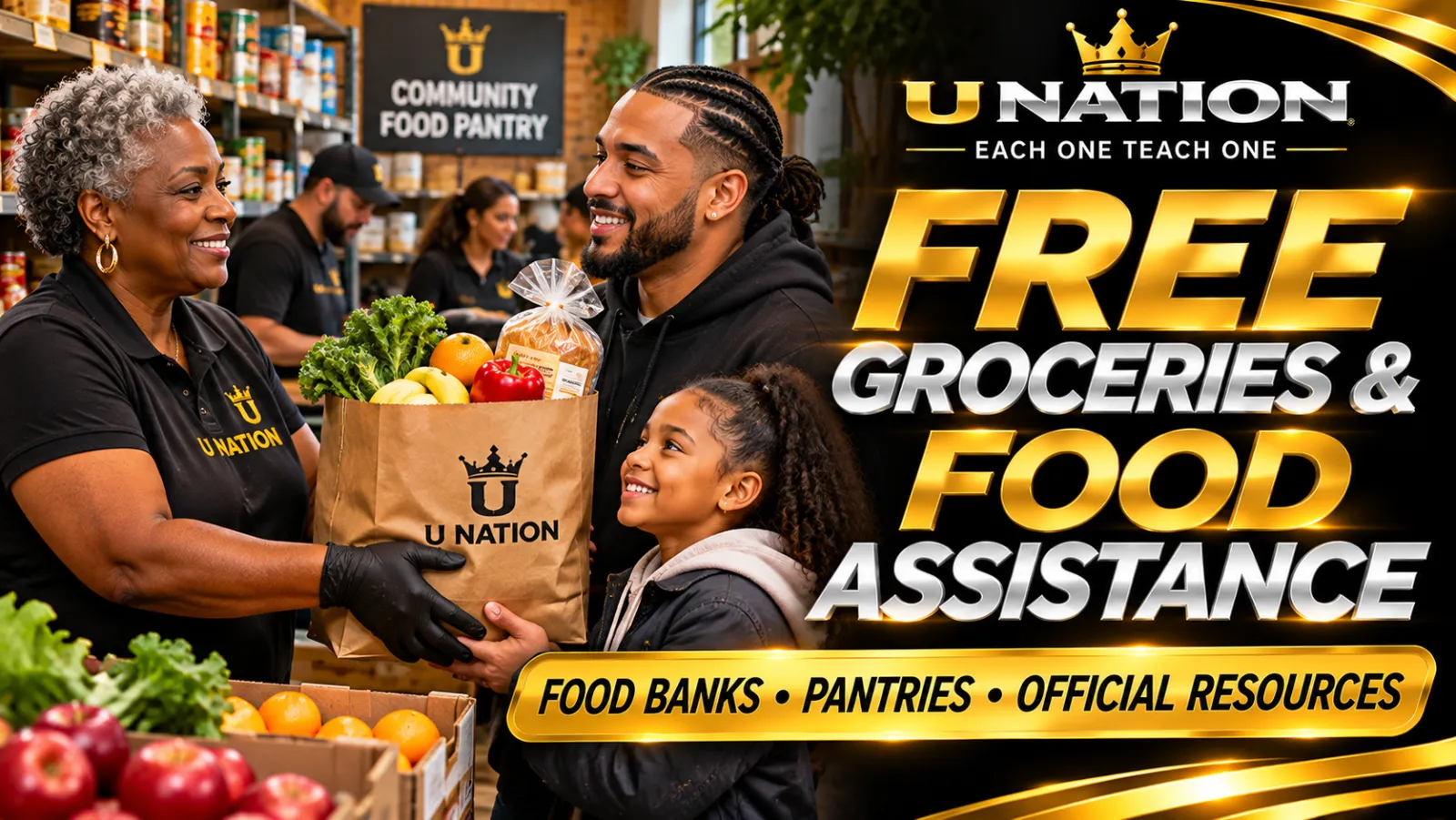
When Groceries Become Difficult to Afford, Knowing Where to Turn Matters
Imagine walking into a grocery store with a limited amount of money and realizing that even basic necessities will cost more than you expected.
You begin calculating what you can afford.
Do you purchase enough groceries for the week, pay the electricity bill, or put gas in the car?
For many households, these decisions are a regular part of managing limited financial resources.
Fortunately, food assistance is available through nonprofit organizations, community agencies, charitable programs, and government nutrition initiatives.
Some programs provide groceries directly. Others offer meals, monthly food benefits, or specialized support for children, older adults, and qualifying families.
The challenge is knowing where to find legitimate resources and understanding how to access them.
At U Nation, our mission is to make useful information more accessible.
Our free grocery directory includes more than 190 food-bank and assistance listings across the United States.
Here's how to get started.
Find Free Groceries Through Feeding America
One of the most useful places to begin is Feeding America.
Feeding America operates a nationwide network of food banks that work with local food pantries, meal programs, and community organizations.
A food bank typically collects, stores, and distributes food through partner organizations.
A food pantry is often where an individual or family can directly receive groceries.
Food bank vs. food pantry
This distinction matters because visiting a food bank's warehouse does not necessarily mean groceries are distributed directly to the public at that location.
How to Find Food Near You
- 1
Step 1: Visit the Food Locator
Visit Feeding America's official food locator: feedingamerica.org/need-help-find-food.
- 2
Step 2: Enter Your ZIP Code
Enter your ZIP code.
- 3
Step 3: Find Your Food Bank
Identify the food bank serving your community.
- 4
Step 4: Locate Partner Pantries
Follow its instructions to locate partner pantries and distributions.
- 5
Step 5: Call Before You Go
Contact the distribution location before traveling. Ask about hours, eligibility, available food, and required documentation.
Some programs serve anyone needing assistance. Others have geographic or household requirements.
Availability can change based on donations, funding, and demand.
Call 211 for Local Food Assistance
Another useful resource is 211.
211 helps connect individuals with community services.
Depending on location, referral specialists may help people find food pantries, meal programs, emergency assistance, or other services.
What Should You Ask?
You can explain your situation and ask:
What to say
"Are there any food pantries or emergency grocery distributions available in my ZIP code today or this week?"
You can also ask about transportation, delivery options, and whether the organization provides groceries or prepared meals.
211 — Community Assistance
The Emergency Food Assistance Program
The Emergency Food Assistance Program, commonly called TEFAP, is administered through the U.S. Department of Agriculture and state agencies.
It provides USDA foods for eligible households at no cost.
States distribute these resources through participating organizations, including food banks, food pantries, and meal programs.
Who Can Qualify?
Eligibility for take-home food generally depends on state income rules.
Some states also recognize eligibility through participation in other qualifying assistance programs.
The requirements are not identical nationwide.
Prepared meals served through eligible organizations may follow different rules.
How to Find TEFAP Assistance
Contact your state's distributing agency or a participating local food organization.
USDA — The Emergency Food Assistance Program
TEFAP can be particularly useful for households seeking supplemental groceries rather than restaurant-style meal assistance.
SNAP: Monthly Assistance for Eligible Households
The Supplemental Nutrition Assistance Program, or SNAP, provides qualifying households with benefits to purchase eligible food.
SNAP is administered by states under federal rules.
Eligibility generally involves household circumstances, income, and other applicable requirements.
Benefits are not automatically available to everyone.
How to Apply
- 1
Step 1: Find Your State Agency
Begin with your state's official SNAP agency.
- 2
Step 2: Review the Rules
Review the application instructions and eligibility information.
- 3
Step 3: Prepare Documents
Prepare the documentation requested by the agency.
- 4
Step 4: Submit Your Application
Submit an application through an authorized channel.
If approved, benefits are generally provided through an Electronic Benefits Transfer card.
USDA — SNAP
Pantries and SNAP work together
Food pantries and SNAP serve different purposes.
A person may be able to use food pantries while also applying for SNAP, subject to the relevant rules.
WIC: Food and Nutrition Assistance for Families
The Special Supplemental Nutrition Program for Women, Infants, and Children is commonly known as WIC.
It supports qualifying pregnant and postpartum people, infants, and children under five.
WIC provides specific nutrition benefits and related services.
The program has eligibility requirements involving factors such as category, residency, income, and nutritional risk.
What Does WIC Provide?
Benefits may include eligible foods, nutrition education, and referrals to other services.
The exact foods and procedures depend on applicable program rules.
USDA — WIC
Families should contact their state or local WIC agency to learn how to apply.
Free Meals for Children
Several nutrition programs support children.
Depending on location and eligibility, families may find assistance through school meal programs and seasonal meal sites.
School Meals
Eligible schools participate in federal breakfast and lunch programs.
Some schools provide free meals to all students through applicable program options.
Others determine eligibility under relevant rules.
Contact your school district for current information.
SUN Meals
SUN Meals provides meals and snacks through participating summer meal sites.
Availability depends on the program, season, and location.
Official resource: fns.usda.gov/summerCheck before you go
Because meal-site schedules can change, families should verify operating dates and locations before visiting.
Food Assistance for Older Adults
Older adults may have access to additional nutrition programs.
Commodity Supplemental Food Program
The Commodity Supplemental Food Program provides supplemental USDA food packages to qualifying adults age 60 and older.
Eligibility and availability depend on program requirements and local participation.
Official resource: fns.usda.gov/csfpMeals on Wheels
Meals on Wheels programs operate through local organizations and may provide delivered meals or other nutrition-related assistance.
The services, eligibility requirements, and possible charges vary by provider.
Official website: mealsonwheelsamerica.orgLocal Food Banks and Community Organizations
Many communities have regional food banks serving several counties.
For example, organizations in the Feeding America network distribute food through community partnerships in cities and rural communities.
Your U Nation PDF includes food-bank listings throughout the country.
However, food-bank names, service areas, pantry schedules, and available programs may change.
Verify every listing
Rather than assuming an older directory listing identifies an active distribution, readers should verify the current location through an official provider.
Other Places to Research
Community action agencies, charitable organizations, faith-based groups, and local nonprofit organizations may offer food assistance.
Some communities also provide mobile food distributions.
Others coordinate food support through schools or neighborhood organizations.
The best available option depends on where you live.
What Should You Bring to a Food Pantry?
Not every pantry requires the same information.
Some may ask for basic household details.
Others may have identification, residency, income, or appointment requirements.
Before visiting, ask whether you need:
- Identification.
- Proof of address.
- Information about household size.
- Income documentation.
- An appointment.
- Reusable grocery bags or containers.
Ask the pantry
Do not assume every food pantry requires proof of income.
Always check with the specific organization.
What If You Need Food Immediately?
If your household has little or no food available, begin with services that provide local referrals.
You can call 211 or use Feeding America's food locator.
USAGov also lists the National Hunger Hotline as a resource for finding emergency food assistance.
USAGov — Emergency Food Assistance
When asking for assistance, explain whether your need is immediate.
You can also ask about prepared meals if a food distribution is unavailable.
Remember that operating hours and available services vary.
Avoid Food Assistance Scams
People seeking emergency resources should be cautious about misleading websites.
Never pay for a pantry address
You generally should not need to pay someone simply to obtain the address of a local food pantry.
Use official government and established nonprofit resources when possible.
Protect your information
Be suspicious of unfamiliar websites claiming to guarantee government food benefits in exchange for a payment.
Do not share banking credentials or sensitive personal information with unverified contacts.
If an organization appears in an online directory, confirm its current information directly before visiting.
How to Make the Most of Available Resources
When you locate a legitimate food-assistance provider, ask about the types of services offered.
Some locations distribute groceries weekly or monthly.
Others offer seasonal assistance or emergency distributions.
You may also find referrals for utility assistance, housing support, or other community services.
Keep a record of the organizations that serve your area.
If one location is unavailable, ask whether another nearby organization can help.
The purpose is to understand the options available rather than relying on one resource.
What U Nation Wants You to Learn
Food assistance is not limited to one program.
Families may find support through food pantries, government nutrition benefits, nonprofit organizations, community meal programs, and regional food banks.
The available programs serve different needs and follow different requirements.
Understanding these differences can help people find appropriate assistance more efficiently.
At U Nation, we believe that sharing legitimate resources is one way to strengthen communities.
Each One Teach One.
Download the Free U Nation Grocery Resource Guide
Want a broader directory of food-assistance organizations?
Our free grocery resource guide includes more than 190 food-bank and assistance listings across the United States, along with information about government food programs and national referral services.
Official Resources
Feeding America — Find Food
211 — Community Assistance
USDA — SNAP
USDA — WIC
USDA — Emergency Food Assistance
USAGov — Emergency Food Assistance
Final Thoughts
Access to food is a basic household need.
When grocery costs become difficult to manage, legitimate assistance programs can provide important support.
Start with official resources, research the organizations serving your community, and verify their requirements.
And when you discover a resource that helps your household, consider sharing that information with someone else who may need it.
U Nation | Dominic Nicholson. Each One Teach One.
Educational Disclaimer: This article provides general educational information. U Nation does not operate the listed food programs, determine eligibility, or guarantee food availability. Funding, program rules, distribution schedules, and service areas may change. Contact providers directly for current information.