Side Income
33 Ways to Earn Money With Your Car: Driving Apps, Delivery Services, Car Wraps & More
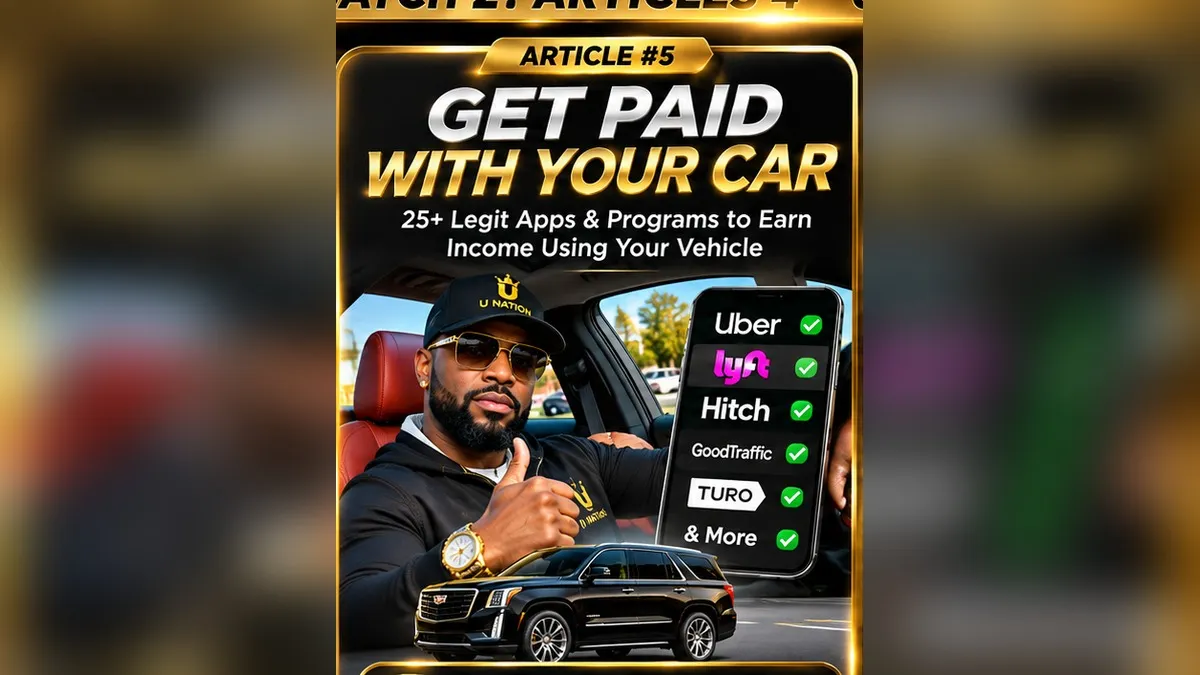
Could Your Car Help You Earn Extra Income?
For many people, a vehicle is one of their largest monthly expenses.
Car payments, insurance, fuel, repairs, and maintenance can consume a significant portion of a household budget.
But some drivers explore ways to use their existing vehicles to generate additional income.
Rideshare services, delivery platforms, advertising campaigns, and other task-based opportunities have created options for eligible drivers.
The important question is not simply how much a platform advertises.
It's how much money you could actually keep after expenses.
Our free U Nation guide identifies 33 driving-related resources across five categories. Some are active platforms, others may have limited geographic availability, and a few are included as historical references.
Here's what to understand before applying.
1. Rideshare: Transporting Passengers
Rideshare platforms connect eligible drivers with passengers seeking transportation.
Examples from our resource directory include:
Check your insurance
Before joining, check whether personal auto insurance covers the activity or whether additional coverage is necessary.
A personal automobile policy may exclude some commercial driving activities.
These platforms have different service areas and operating models.
Not every company recruits drivers in every city.
Drivers may be required to meet vehicle-age restrictions, licensing requirements, insurance rules, background checks, and other eligibility standards.
2. Delivery Apps: Transporting Food and Goods
Delivery work is another option for people with eligible vehicles.
Your original PDF lists services including:
Some opportunities involve delivering meals, while others involve groceries, retail purchases, packages, or larger items.
The type of vehicle required may depend on the assignment.
A compact car may work for some deliveries but not for moving bulky commercial materials.
Availability also varies with demand and the number of participating drivers.
What about advertised hourly earnings?
Approach earnings estimates carefully.
A platform may advertise potential compensation before expenses.
For example, a driver receiving $120 in gross compensation during a work period has not necessarily earned $120 in profit.
Fuel, tolls, maintenance, depreciation, insurance, and taxes can reduce the actual benefit.
Keep records of your operating expenses so you can evaluate whether the opportunity makes financial sense.
3. Car Wrap Advertising: Getting Paid to Display Advertisements
Some companies coordinate advertising campaigns using privately owned vehicles.
A participant may be selected to display branded graphics on a car for a defined campaign period.
The U Nation directory includes:
These are research leads, not a confirmation that each provider currently offers paid campaigns to consumers.
Some focus on commercial fleets, advertisers, or specialized markets.
Driver enrollment, campaign availability, and compensation must be verified individually.
Important: Car Wrap Scams
The Federal Trade Commission warns about fraudulent advertising offers that promise easy money for displaying advertisements on cars.
A common scam involves someone sending a check and telling the driver to forward part of the funds to a supposed vehicle-wrap installer.
The check later turns out to be fraudulent.
The person who deposited it may be responsible for the money sent away.
Read the FTC's official warning
Never send money to a supposed installer
Never send money to a supposed installer based on an unsolicited check.
4. Mystery Shopping and Evaluation Assignments
Some companies pay selected contractors to evaluate customer experiences.
Assignments might involve visiting a store, examining a service, completing a purchase, or documenting an interaction.
The original resource list includes:
Official warning
Mystery shopping scams
The FTC also warns that scammers impersonate mystery-shopping businesses and send fake checks or demand gift-card purchases.
Never pay money to obtain a supposed guaranteed assignment.
Mystery shopping is not always a driving job. Some assignments merely require traveling to a location.
Legitimate opportunities may be occasional rather than full-time.
5. Renting Out Your Vehicle
Another income model involves allowing eligible people to rent a privately owned vehicle through a platform.
The U Nation guide identifies Turo as a research option.
Before considering vehicle sharing, investigate insurance protection, deductibles, eligibility rules, vehicle wear, maintenance responsibilities, and local restrictions.
Important directory update
Importantly, the original guide also lists Getaround and HyreCar as historical references. They should not be promoted as currently operating U.S. driver-income opportunities, because their U.S. operations ended in 2025.
A platform being included in an older resource directory does not mean it remains available.
6. Calculate Your Real Profit Before Applying
Imagine a driver earns $500 from a combination of deliveries and other eligible assignments during a week.
That figure represents gross receipts, not necessarily profit.
The driver would still need to account for expenses such as fuel, parking, tolls, maintenance, and any additional coverage.
Income taxes may also apply.
Keeping business records helps distinguish money received from actual economic benefit.
The IRS provides educational information for independent contractors and gig workers:
IRS — Gig Economy Tax Center
Tax deductions and reporting rules depend on the taxpayer's circumstances.
7. Questions Every Driver Should Ask
Before joining a platform, investigate the following:
- 1
Is the platform accepting applicants in my city?
Some services may maintain waiting lists or operate only in selected markets.
- 2
What vehicle is required?
Check vehicle age, condition, inspection, registration, and licensing requirements.
- 3
What insurance is necessary?
Do not assume your personal policy covers every commercial activity.
- 4
How is compensation calculated?
Understand whether the platform pays per order, delivery, assignment, approved task, or rental period.
- 5
When will I receive payment?
Research withdrawal methods, payment schedules, and possible fees.
- 6
What expenses am I responsible for?
Compare expected compensation with the cost of operating your vehicle.
8. What U Nation Wants You to Learn
There is no single driving opportunity that works equally well for everyone.
A person living in a busy metropolitan area may encounter different opportunities from someone in a rural community.
A vehicle suitable for food delivery may not meet the requirements for transporting passengers or large items.
And an advertising opportunity may depend on the availability of campaigns rather than how many miles someone drives.
Successful research involves comparing options, verifying current eligibility, and understanding the financial risks.
The goal is informed decision-making—not chasing unrealistic earnings promises.
Each One Teach One.
Download the Free Driver Income Resource Guide
Want the complete directory?
Our U Nation PDF contains 33 driving-related resources covering car advertising, rideshare, deliveries, mystery shopping, and vehicle rental opportunities.
Official Educational Resources
FTC — Car Wrap Scam Warnings
FTC — Mystery Shopping Scams
IRS — Gig Economy Tax Center
U Nation | Dominic Nicholson. Each One Teach One.
Educational Disclaimer: This article does not guarantee employment, acceptance, available assignments, rental income, or earnings. Platform availability, compensation, fees, insurance, and eligibility can change. Independently verify all offers before providing personal information or paying money.