Resources & Assistance
How to Get Free Groceries and Food Assistance Near You: A Complete Step-by-Step Guide
Each One Teach One — Because Knowledge Should Be Shared.
Introduction: You May Have More Food Assistance Options Than You Realize
Groceries are one of the most important expenses in every household. Whether you're raising children, attending school, working full-time, living on a fixed income, or experiencing an unexpected financial emergency, keeping food on the table can become challenging.
Fortunately, communities throughout the United States have organizations dedicated to helping individuals and families access food.
Many people are familiar with food stamps, officially called the Supplemental Nutrition Assistance Program (SNAP). However, SNAP is only one part of a much larger network of resources.
Across the country, nonprofit organizations, local food banks, government agencies, churches, schools, community centers, and charitable organizations distribute groceries and meals to eligible individuals.
Some programs offer emergency food boxes. Others provide fresh produce, pantry staples, prepared meals, or referrals to nearby assistance providers.
Certain organizations may also help people apply for longer-term nutrition benefits.
The biggest challenge is often knowing where to start.
At Bagzamilleon | U Nation, we believe financial education should include resources that help people meet their everyday needs.
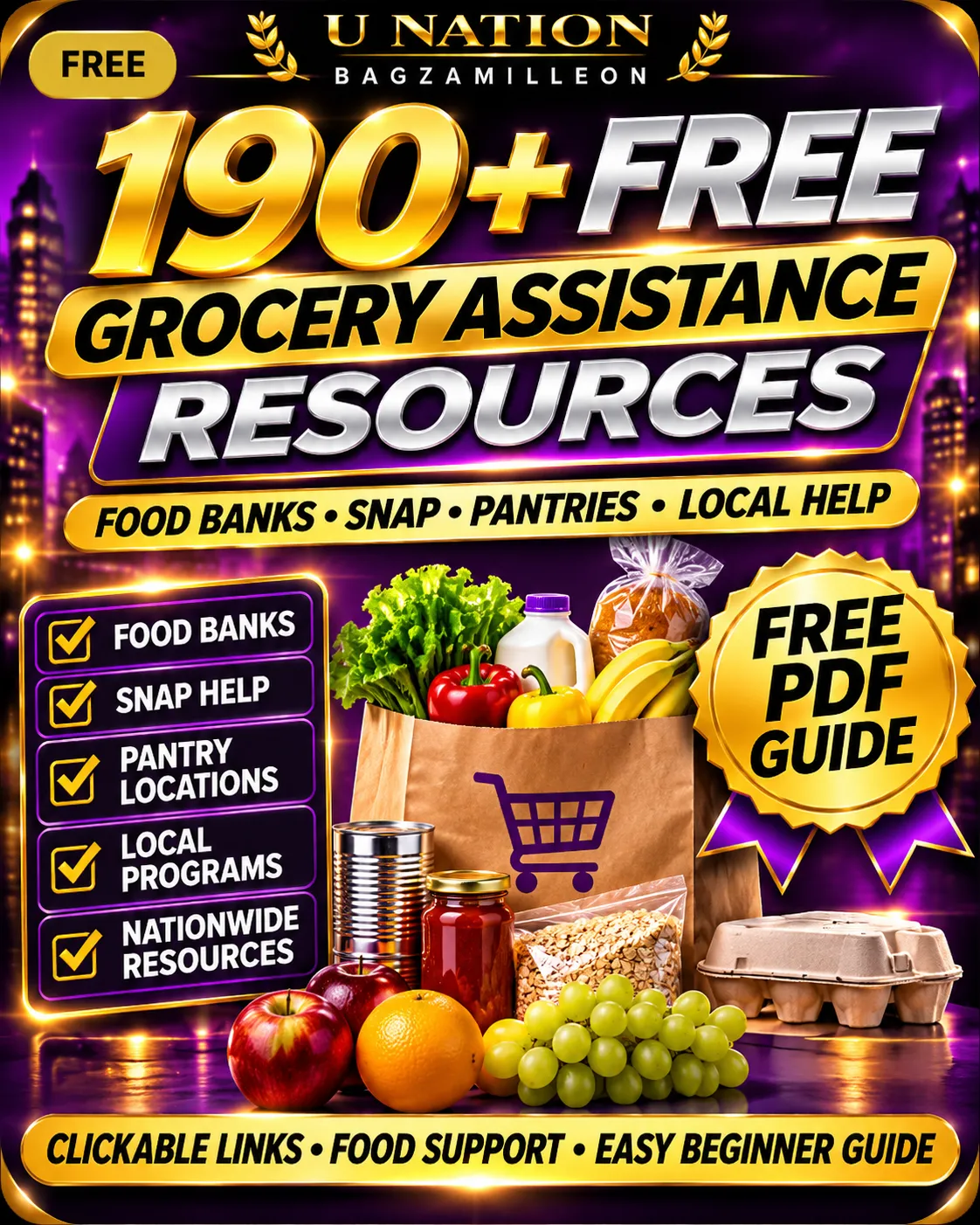
That's why we've created our 190+ Free Grocery & Food Assistance Resources Guide, designed to help people explore food banks, community assistance organizations, and nationwide food assistance directories.
This article explains how to locate these resources, understand basic eligibility requirements, contact organizations, and take practical steps toward receiving assistance.
Need help finding groceries? Start with the free guide below.
Understanding How Free Grocery Assistance Works
Before searching for assistance, it's helpful to understand the different types of organizations involved.
What Is a Food Bank?
A food bank is generally a large nonprofit organization that collects, stores, and distributes food to smaller community organizations.
Food banks may receive donations from grocery stores, manufacturers, farmers, businesses, and individuals.
Many food banks distribute food through partner organizations rather than providing groceries directly to the public.
These partners can include neighborhood food pantries, churches, schools, and mobile food distribution programs.
What Is a Food Pantry?
A food pantry typically distributes groceries directly to individuals and households.
Depending on the organization, available items may include:
- Canned vegetables and fruit
- Rice, pasta, and cereal
- Beans and other protein sources
- Bread and bakery products
- Fresh fruits and vegetables
- Milk and other dairy products
- Frozen or refrigerated foods
The exact selection changes based on donations, available inventory, and the organization's resources.
Some pantries let visitors choose their groceries, while others provide prepared food boxes.
What Is a Mobile Food Pantry?
A mobile food pantry distributes food at temporary locations, such as parking lots, schools, community centers, and neighborhood gathering places.
These distributions may operate weekly, monthly, or on special dates.
They can be especially useful for communities without a permanent neighborhood pantry.
Confirm before you travel
Food distribution schedules can change. Always confirm the location, time, and requirements before traveling.
How to Find Free Groceries Near You
The easiest way to begin your search is by using a nationwide directory.
These directories help connect people with organizations serving their communities.
Feeding America: Find Local Food Banks
Feeding America operates a nationwide hunger-relief network that connects individuals with regional food banks and their local partners.
Its website provides a ZIP-code search tool.
How to use Feeding America:
- 1.Open the Feeding America food assistance website.
- 2.Find the food bank search tool.
- 3.Enter your ZIP code.
- 4.Review the regional food bank serving your area.
- 5.Open the organization's website.
- 6.Look for nearby food pantries, mobile distributions, or meal programs.
- 7.Contact the organization to confirm available services.
Feeding America — Find Your Local Food Bank
One important distinction
The nearest regional food bank may not be where individuals pick up groceries. The regional organization can help you locate its distribution partners.
211: Find Local Emergency Assistance
Another important resource is 211.
In many communities, 211 connects individuals with local health and human services.
These services can include food assistance, housing assistance, utility assistance, and other community resources.
You can usually reach the service by dialing 211.
Explain that you're looking for free groceries or emergency food assistance.
You can ask the representative:
211 — Community Assistance
What to say
"Are there any food pantries or emergency grocery distribution programs near my ZIP code that are currently accepting households?"
The representative may provide information about nearby organizations, their contact details, and the next steps.
Availability depends on your location.
WhyHunger: Emergency Food Assistance
WhyHunger provides a nationwide food assistance database and hotline.
Its resources help individuals locate community food pantries, meal programs, and other hunger-relief organizations.
You can contact WhyHunger by calling 1-800-548-6479.
You can also text your ZIP code to that number or use its online food finder.
When using the directory, search your location and review the nearby organizations.
Contact the provider directly to verify current service hours and availability.
WhyHunger — Find Food
How to Get Emergency Food Assistance When You Need Food Immediately
Sometimes a household cannot wait several days for an appointment or benefit application.
When groceries are urgently needed, focus on programs offering emergency or same-day assistance.
Start by contacting 211 and explaining your situation.
You can also call the USDA National Hunger Hotline at 1-866-348-6479.
The hotline operates Monday through Friday, from 8 a.m. to 8 p.m. Eastern Time.
Ask about emergency food providers serving your neighborhood.
If you cannot reach a hotline, try locating a nearby community pantry, religious organization, or soup kitchen.
When contacting an organization, be specific about your situation.
Explain whether you need groceries for a household, ready-to-eat meals, or assistance for children.
Ask whether the organization has food available that day.
Also ask about transportation requirements.
Some programs offer drive-through distributions, while others provide walk-up services.
If the first organization cannot help, request another referral.
A pantry that has exhausted its supplies may still know about another provider operating nearby.
USAGov — How to Get Emergency Food Assistance
How to Apply for SNAP Food Assistance Benefits
SNAP is one of the major government programs designed to help eligible households purchase food.
SNAP benefits are generally delivered through an Electronic Benefits Transfer card, commonly called an EBT card.
Eligible households can use SNAP benefits to purchase approved food items at participating retailers.
SNAP is different from a food pantry because participants use their benefits to purchase eligible groceries.
Step-by-Step SNAP Application Process
- 1
Find Your State's SNAP Office
SNAP applications are managed by state or local agencies. Start with the official SNAP State Directory. Select the state where you live and follow the application instructions provided by that state.
- 2
Review Eligibility Requirements
Eligibility generally depends on factors such as household income, household size, and other applicable program rules. Certain deductions and additional eligibility rules may also affect the determination. Requirements vary by household circumstances and applicable federal and state policies.
- 3
Gather Your Information
Depending on your circumstances, the agency may request identification, household information, income documentation, housing expense information, utility expense information, and other records relevant to eligibility. Use the checklist supplied by your state agency rather than assuming every document will be required.
- 4
Submit Your Application
States may offer online, telephone-assisted, mail, or in-person application options. Follow your state's official process.
- 5
Complete Any Required Interview
Some applicants must complete an eligibility interview. Respond promptly to requests for additional information.
- 6
Monitor Your Application
Keep your application confirmation number and watch for notices from the agency. If approved, your state will explain how your benefits are issued and used.
What If You Need Food Before SNAP Is Approved?
Do not assume that you must wait for SNAP approval before visiting a food pantry.
Food pantries and SNAP are separate types of assistance.
Contact local hunger-relief organizations while your application is being reviewed.
Some households may also qualify for expedited SNAP processing under applicable rules. Ask your state agency if you have an urgent need.
Government Programs That May Provide Free Food
In addition to SNAP, other government nutrition programs support eligible households.
These programs have different requirements, so one person may qualify for a service that another household does not.
The Emergency Food Assistance Program
The Emergency Food Assistance Program, commonly called TEFAP, provides USDA foods to participating state and local organizations.
These organizations distribute food through approved community partners.
Food may be provided through food pantries or prepared-meal programs.
Eligibility requirements for groceries taken home are established by participating states.
To find assistance, contact your state's TEFAP distributing agency or ask a local food bank about participating providers.
USDA — TEFAP State Contacts
WIC: Food Assistance for Women, Infants, and Young Children
The Special Supplemental Nutrition Program for Women, Infants, and Children, known as WIC, provides nutrition-related support to eligible participants.
Depending on eligibility, WIC may help:
- Pregnant individuals
- People who recently gave birth
- Breastfeeding parents
- Infants
- Children younger than five
USDA — How to Apply for WIC
Services can include access to eligible foods, nutrition education, and referrals to additional resources.
Applications are handled through state or local WIC agencies.
Contact your state's WIC program to review eligibility and determine which documents to bring.
Free and Reduced-Price School Meals
Families with school-age children should also investigate school meal programs.
Eligible students may receive free or reduced-price meals at participating schools.
Some schools provide meals at no charge to all students through specific programs.
Parents and guardians can contact their school district to learn about the available options.
If your household experiences a change in income during the school year, ask whether you can submit a new application.
USDA — National School Lunch Program
Summer Food Programs for Children
When schools are closed for summer, some families lose access to meals their children ordinarily receive during the school year.
Summer meal programs can help address that gap.
In participating areas, eligible children may also receive Summer EBT grocery benefits.
Availability, eligibility, and application requirements depend on where the family lives.
Check official state and federal resources before relying on a program.
USDA — Summer Meals
USDA — SUN Bucks (Summer EBT)
Free Grocery Resources for Seniors and People With Limited Mobility
Older adults and individuals with mobility challenges may have additional food assistance options.
Some communities operate senior nutrition programs, meal delivery services, and food distribution programs designed for older residents.
Available services can include:
- Meals delivered to the home
- Congregate meals at senior centers
- Food pantry assistance
- Referrals to local nutrition services
- Community transportation assistance
Eligibility depends on the program.
Some programs use age-based requirements, while others consider income, disability, mobility, or other circumstances.
How to Find Senior Food Assistance
Start with your local Area Agency on Aging or community aging-services office.
Ask about meal delivery, senior food distributions, and nutrition programs.
You can also contact 211 or your regional food bank.
When contacting an organization, explain whether the person needs delivery, transportation assistance, or food that meets a particular dietary requirement.
Not every program offers delivery or specialized food, so verify those services before applying.
Eldercare Locator — Find Your Area Agency on Aging
Meals on Wheels America
How to Find Free Groceries Through Local Churches and Community Organizations
Government agencies are not the only source of food assistance.
Many nonprofit organizations and faith-based groups operate food pantries or emergency meal programs.
These organizations may include local churches, neighborhood community centers, nonprofit outreach programs, and charitable organizations.
Some distribute groceries regularly.
Others operate seasonal food drives or provide emergency assistance when supplies are available.
How to Search Your Community
Begin with your city or county and the words "food pantry." You can also search for:
- "Free grocery assistance near me"
- "Emergency food pantry"
- "Community food distribution"
- "Free food pickup"
- "Mobile food pantry"
- "Food assistance for families"
Check the organization's official website or contact number before visiting.
Do not rely exclusively on older social media posts because distribution dates and inventory can change.
What Should You Ask?
When you contact a community organization, ask:
What to say
"Hello, I'm trying to locate free groceries for my household. Are you currently distributing food, and what requirements do I need to meet?"
Ask whether an appointment is required, whether the program serves your ZIP code, and what documentation you should bring.
You can also ask if the organization knows about other services in the area.
What Documents Might You Need to Receive Free Groceries?
One common question is whether someone needs identification to visit a food pantry.
The answer depends on the individual organization and the program distributing the food.
Some community pantries have minimal requirements.
Others may request proof of residency, household information, income documentation, or an appointment.
For example, a pantry funded through one program may operate under different eligibility requirements than a privately funded neighborhood food distribution.
Before visiting, ask about:
- Identification: Does the program require a government-issued ID or another form of identification?
- Proof of address: Does the organization serve specific neighborhoods, ZIP codes, or counties?
- Income requirements: Is eligibility determined by household income?
- Household size: Does the organization need to know how many individuals live in the household?
- Appointment requirements: Can visitors arrive during posted hours, or is advance registration necessary?
- Pickup frequency: How often may a household receive assistance?
- Transportation: Is there a walk-up option, drive-through pickup, or delivery service?
Getting these answers before traveling can save time and prevent unnecessary frustration.
Can You Receive Food Pantry Assistance While Working?
Many people assume food assistance is reserved exclusively for individuals who are unemployed.
That assumption is incorrect.
Employment by itself does not automatically prevent someone from receiving assistance from every food pantry or nutrition program.
Different programs have different eligibility requirements.
For example, a household may have employment income but still experience financial difficulty because of housing expenses, transportation costs, medical bills, or the number of people supported by that income.
Some privately funded pantries may serve anyone experiencing food insecurity.
Government-supported programs may apply specific income or other eligibility rules.
The best approach is to contact the organization and ask about its requirements.
Do not assume you are ineligible simply because you have a job.
Similarly, do not assume approval is guaranteed because your income falls below a particular amount.
Always let the administering agency or organization determine eligibility.
How to Find Grocery Assistance in Your State
Food assistance programs often operate through regional networks.
That means the resources available in Texas may differ from those offered in California, Florida, New York, Georgia, or another state.
The most effective search process combines a nationwide directory with local information.
- 1
Start With Your ZIP Code
Use Feeding America's food bank finder or another established food assistance directory.
- 2
Identify the Regional Food Bank
Find the organization serving your county or surrounding communities.
- 3
Search Its Local Distribution Network
Look for partner food pantries, community distributions, schools, or mobile food pantry schedules.
- 4
Review the Requirements
Check whether the program has eligibility restrictions, registration requirements, or distribution limits.
- 5
Contact the Provider
Verify the date, time, address, and availability.
- 6
Keep Multiple Options
Do not rely on a single pantry. Save the contact information for several organizations in case your first choice is unavailable.
- 7
Share Helpful Information
If you find a legitimate assistance program, consider sharing its official contact information with someone else who might need it.
This is the idea behind U Nation: Each One Teach One.
Helping people locate trustworthy information can make a meaningful difference.
How to Avoid Food Assistance Scams
When searching for free resources, protecting your personal information is important.
Unfortunately, misleading advertisements and impersonation scams can target people seeking assistance.
Use established nonprofits, official government websites, and verified community organizations whenever possible.
Be cautious when a website claims that everyone automatically qualifies for a specific grocery allowance or payment.
Also be cautious if someone requests an upfront processing fee in exchange for revealing the location of a free pantry.
Legitimate government benefit programs have official application procedures.
Before sharing sensitive personal information, verify that you are communicating with the actual agency or approved application provider.
Protect your information
Never share your EBT PIN with an unverified third party.
Do not provide passwords, banking credentials, or identity documents to a website simply because it promises free groceries.
If an offer appears suspicious, contact the organization through the telephone number or website listed in its official directory.
Remember that a program providing food at no cost is not necessarily the same as a government cash benefit.
Understanding that distinction can help you avoid misleading claims.
How to Prepare for Your First Food Pantry Visit
If you've never visited a food pantry, preparing beforehand can make the experience easier.
First, confirm that the organization is open and distributing food.
Second, ask whether you need to register or bring documentation.
Third, check whether there are limits on how often you can receive assistance.
Fourth, bring reusable shopping bags or a cart if the organization recommends them.
Fifth, ask whether you can pick up food for another household member if that person cannot travel.
Some organizations may require written authorization or have specific rules for representative pickup.
Also consider asking about the types of groceries available.
For example, if you have a food allergy or dietary restriction, explain your needs to the provider.
Not every pantry can accommodate specific dietary requirements, but asking ahead may help.
If the organization cannot provide food that day, request information about nearby alternatives.
Frequently Asked Questions About Free Groceries
Are Food Banks Really Free?
Food banks and their community partners commonly distribute food at no cost to eligible recipients.
However, services, eligibility requirements, and distribution arrangements differ.
Contact the organization directly for current information.
Do I Need to Receive SNAP to Visit a Food Pantry?
Not necessarily.
Food pantries may operate independently of SNAP and apply their own eligibility requirements.
Some TEFAP distributions have state-established rules.
Ask the provider which requirements apply.
Can Seniors Receive Free Grocery Assistance?
Yes, seniors may be eligible for local pantry services, nutrition programs, senior meal services, or other community assistance.
Availability depends on location and program requirements.
Can College Students Receive Food Assistance?
Some colleges and universities operate campus food pantries.
Students may also qualify for community assistance or certain government nutrition programs, depending on applicable eligibility rules.
Contact the school's student services office and check local food banks.
Can Families With Children Receive Additional Help?
Families may qualify for programs such as SNAP, WIC, school meals, or summer nutrition assistance.
Eligibility varies by program and household circumstances.
How Often Can Someone Visit a Food Pantry?
Every organization sets its own service schedule and distribution rules.
Some programs operate weekly, while others offer monthly distributions or emergency assistance.
Always confirm the organization's current policies.
What If I Don't Have Transportation?
Ask whether the organization offers delivery, a walk-up distribution, or transportation referrals.
You can also contact 211 to ask about food assistance options accessible by public transportation.
Get Your Free Grocery Assistance Resource Guide
Finding food assistance should not require spending hours searching through unreliable websites.
That's why Bagzamilleon | U Nation has made this grocery assistance guide available as a free educational download.
The guide organizes more than 190 resource entries and references, including food banks, pantry networks, and nationwide search tools.
It is designed to give readers a practical starting point for exploring assistance.
Inside, you'll find resources that may help you:
- Identify organizations serving your region
- Locate nationwide food assistance directories
- Learn about emergency grocery services
- Find government nutrition program information
- Contact food assistance providers
- Ask the right questions before visiting a pantry
The directory is a research resource, not a guarantee that every listed organization has food available at all times.
Readers should confirm service areas, eligibility rules, contact details, and distribution schedules directly with providers.
Price: FREE — $0.00. Digital download available through the U Nation Free Resources collection.
Final Thoughts: Sharing Resources Can Strengthen Communities
Food assistance is about more than receiving groceries.
For many households, having access to emergency food can help ease financial pressure during difficult periods.
It may allow someone to direct limited funds toward housing, transportation, utilities, or other essential expenses.
For a parent, access to a local food pantry may mean having additional meals available for their children.
For a senior living on a fixed income, community food assistance may provide support when expenses increase.
For a student balancing education and employment, a campus pantry may offer temporary relief.
The circumstances are different, but the importance of having access to reliable information remains the same.
At U Nation, our mission is to connect people with useful knowledge and encourage community support.
We believe that when someone discovers a legitimate resource, sharing that information can help another person take a meaningful step forward.
Financial education is not just about building businesses or learning how money works.
It's also about understanding the resources available to support everyday life.
If this article helped you discover something new, consider sharing it with your family, friends, and community.
Someone you know may be looking for exactly this information.
Bagzamilleon | DominicRNicholson.com
U Nation — Each One Teach One.
Educational Disclaimer: This article and its accompanying resource guide are provided for general educational and informational purposes by Bagzamilleon | U Nation. We are not affiliated with, sponsored by, or endorsed by the government agencies and independent organizations discussed unless expressly stated. Program availability, eligibility, income requirements, application processes, distribution schedules, and available food may change. The inclusion of an organization or resource does not guarantee eligibility, approval, or access to food assistance. Always verify information directly with the program administrator or its official website before submitting personal information, applying, or traveling to a distribution location. No payment is required to access this U Nation digital guide.